

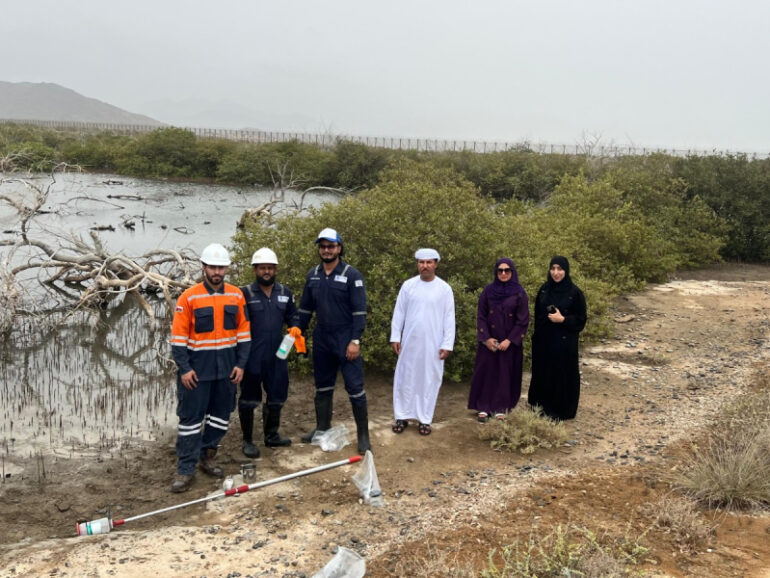
Muscat – Environment Authority in North Batinah has completed Phase 1 of a scientific assessment and rehabilitation project in Khor Kalba in Shinas, confirming that the coastal wetland remains in a stable ecological condition. Phase 1 focused on soil and water sampling, biodiversity surveys and an evaluation of mangrove health. The findings show that the […]
Muscat – Environment Authority in North Batinah has completed Phase 1 of a scientific assessment and rehabilitation project in Khor Kalba in Shinas, confirming that the coastal wetland remains in a stable ecological condition.
Phase 1 focused on soil and water sampling, biodiversity surveys and an evaluation of mangrove health. The findings show that the khor supports healthy mangroves, diverse vegetation and a range of resident and migratory bird species.
A rehabilitation work is scheduled to begin in January 2026 and continue through the end of the year. Phase 2 of the project will centre on mangrove planting, improving water quality and removing pollutants.
Shimaa Hashel Hilal al Saadiya, Environmental Specialist and Project Supervisor, told Muscat Daily that Phase 1 ran from January to November 2025 and relied on several scientific indicators to assess the site.
“We collected and analysed samples of soil, water, snails and mangrove trees from several locations across the khor,” she said. “Laboratory tests measured salinity, pH and levels of heavy metals, including lead, cadmium and mercury.”

Samples were also collected and examined to assess how organisms are responding to environmental pressures. Surveys covered mangrove density and natural regeneration, as well as plant and bird populations, alongside analysis of natural and human-related pressures on the ecosystem.
Shimaa said the mangrove ecosystem remains in good condition and retains its capacity for natural regeneration. Vegetation surveys identified species typical of coastal wetlands, including Avicennia marina and Salicornia.
The khor provides habitat for several bird species, including rock heron, little egret, intermediate egret, water thick-knee, little ringed plover, striated heron, green sandpiper, greater sand plover, house sparrow and crow.
Pollutant levels in soil and water were found to be within safe limits, with no elevated concentrations recorded.
Rehabilitation measures planned for 2026 include planting mangroves – only the local Avicennia marina species. Water-cleaning operations will involve removing dead vegetation and waste, as well as dredging sediment to improve water circulation. Several government bodies are expected to take part in the programme.
According to Shimaa, ecological recovery would take place gradually after Phase 2 is completed. Community participation will not be included, as the khor is in a border area.
Long-term plans include improving community environmental awareness to prevent pollution.
On the potential for eco-tourism, Shimaa said the matter would be assessed at a later stage. “Any future plans would prioritise ecosystem protection and biodiversity.”Khor Kalba mangroves survey
 Certified products under Omani Quality Mark rise
 Historical Association explores Adam, birthplace of Al Busaidi State founder
 Oman announces fine waivers for transport sector
 North Sharqiyah sets up award for manufacturing sector
 Oman esports team qualifies for FIFAe World Cup
 Oman steps up decentralisation efforts to empower governorates